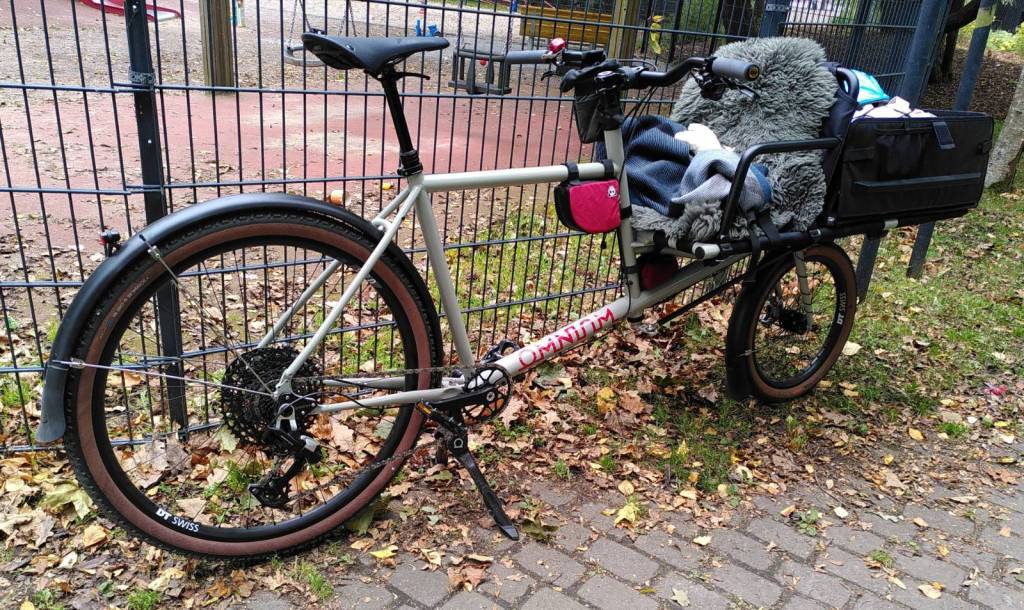
The front wheel of our Omnium Cargo is a DT Swiss U663 laced to a SON 28. We got the Omnium about a month ago, so I knew there wouldn’t be a lot of ride time before I wanted to switch to winter tires, as we plan on both using this as primary kid and shopping transport all year. I’m taking this as an opportunity to experiment with a more performance-oriented setup for a few months. With new bike builds I also like to try newish tech that I haven’t had much hands-on experience with. Decided it was a good chance to finally try tubeless tire inserts. I’ve also been curious about the new line of wider Schwalbe G-One ‘Pro’ tires that have gotten a lot of buzz this year. Also using Eagle 90. My thoughts on the G-Ones and Eagle will come later. First impressions on both are very good.
But to match the rear G-One of course there is a problem (at least in my mind–‘I’m no longer happy but I’m dressing matchy‘), because the only 20″ tubeless tires are mountain bike tires. The only performance road 20″ tire is this G-One Allround that Schwalbe makes for these new Brompton gravel bikes with bigger wheels. I was able to track one down from Germany. I really do not like these G-One Allrounds, and I don’t have much confidence in their puncture protection, but usually tubeless solves this. So everything seems to fall in place well for these wheel-tire combos.
I am pretty loyal to Effetto Mariposa. I wish their stuff got more general attention, because they are one of the few brands that seems genuinely committed to environmentally responsible products. Of course they also have plenty of normal and made-in-china products, so the scope is limited, but their eco products are not just greenwashing and they are both well-designed and performance-oriented. I exclusively use their Flowerpower wax, Vegetalex sealant, Alpine Extra degresser, and tubeless rim strips, and they are all great.
So I’m trying Effetto Mariposa’s Tyreinvader inserts in these Schwalbe tires. I had to guess and cut one of them to fit in the 20″ wheel, but it seems to work well because the circumference can be a bit flexible by adjusting the zip ties that connect the ends. They are extremely light and much less material than other tire inserts, because they are really just a small foam protective layer rather than a true insert. Let me tell you, installation was a pain, but I don’t think it was as bad as Cushcores, for example. I don’t think I would want to do it outside a shop, and this recent failure confirmed I don’t want to be messing with these by a trail.
On initial setup, I tried once, and the insert wanted to tilt so that it wasn’t resting on the tops of both rim walls and centered in the tire, but instead one end was in the rim well and the other sitting up on the other rim wall. You can imagine it is very difficult to manipulate this twisty foam thing by massaging the outside of a tire when the tolerances are basically millimeters. I wanted to give up, but decided to take a break and try again. For the second attempt I sacrificed being able to move the insert directly and put it in the tire as best I could and then mounted both beads. While mounting the tire this way was very difficult because the insert was in the way, once the tire is installed, it was easier to get both tire beads into the center of the rim well and then straighten the insert in the middle of the tire and resting on both rim walls. This technique worked well and it set perfectly and inflated and held air.
The insert I used was the 40mm model, the tire is 54-406, and the rim is 30/35 internal/external. I don’t think this combination is ideal because it is at both the higher tire width and rim width recommendation for this size insert. So the insert is both slightly too narrow to sit stably on the rim and too wide to fit into the tire without wanting to tilt or bend. I had the same problem with the rear tire, which was 50mm so the insert wanted to compress even more. I need my hands on more of these inserts to experiment with combinations that work, because the design is great and I love the relative simplicity compared to other inserts.
The inserts have performed great for a month+. It’s great getting rid of rim strike worries, especially on a cargo bike where load is high and willingness to adjust tire pressures is low. It came in handy because the rear tire was leaking out of the sidewalls for about a week before it sealed up, and sometimes we were riding it with very low pressure.
So what caused my roadside problems yesterday? The difference between the front and rear wheels is another Effetto Mariposa story. I have the rubber tubeless rim strip in the rear, but of course they don’t make a rim strip for 20″ wheels. These strips are very stretchy and durable rubber strips meant to replace tubeless tape, or convert non-tubeless rims. I use them on everything and love not having to worry about damaging tape or replacing and throwing away so much tape to fix a leak. (Though installing their fat bike rim strip to stretch onto 26″ Rolling Daryls was definitely the most I’ve every sweat doing any kind of bicycle maintenance and repair.) Similarly to the inserts, though, the limited widths of tape means that you have to know if your combination of inner rim width and strip will work. Now I’ve been using the strips for long enough on enough wheels to have a good sense of what works.

Last week I was moving a car seat we rented and noticed I hadn’t pumped the front tire in some weeks, so it was probably lower pressure than it should have been. I think that the tight tolerances meant that, when the pressure was low enough for the insert to do its job, one side slipped from of top of the rim wall into the rim well. And I think this somehow damaged or displaced the rim tape, and caused it to start leaking. I haven’t had this problem with low pressures on the rear wheel because it has the rubber rim strip rather than tape.
As usual, my stubbornness got in the way of an efficient repair. I tried many times in the morning to fill the tire again, bounce the leaking spot, add more sealant, etc. etc., which would seem to work but then would be empty when I checked on it later. I finally couldn’t procrastinate leaving to return the car seat any longer, so I decided to just roll away and see what would happen.
Of course I didn’t get far before it was flat, but I was actually glad to be somewhere else than my yard to be troubleshooting my problems. I sat at a picnic table at Kirsikkapuisto, propped the bike up with the car seat, and finally decided to take the tire off. But did I save time and just put a tube in or reset the insert like I did with the technique I discovered when installing it the first time? No, though I didn’t really feel like doing the latter outside of a shop. The other bead was still set on the rim, and I didn’t want to try to set the tire again with a small handpump, so for some reason I decided to try new methods for getting the insert square inside the tire. This was kind of ignoring the leaking issues, because for some reason I thought that if I rest the insert the sealant would work better and the tire would seat.
I tried this three times and got slimier and slimier hands so even though it seemed to want to work, I just had to put in a tube in the end. It’s funny looking at the above picture now, because that’s basically a tube in there. When everything goes well, you don’t think like this, but when you find yourself trying to understand why the thing inside your tire isn’t working, it might as well be a tube. So small wheel tubeless tire insert experiment is over for now. I liked it while it lasted, and I really should have just checked the pressure before riding with it so low. But I guess this is the kind of thing you want to avoid in the first place by using a tire insert. And eventually as I was wrestling with that insert it just became comical why I was wrestling that flat red foam thing instead of just sticking a tube in its place. Guess I will have forgotten this next spring when I decide to try this setup again.
 almost anything
Leave a comment