
Bicycles don’t appear very often in literary fiction. Even though they are a part of most peoples’ daily lives and have been for a long time, they are difficult to describe, I think. And fiction is where artists try really hard to arrange descriptions of things into stories that make us think about these things, and other things. All the material realities of transportation, like the environment that is traveled through, is usually backgrounded unless it interrupts the story in some way, so it is hard to place a recognizable bicycle into a story without it being broken or symbolic or weird.
Also most people don’t think about the aesthetic function of bicycles, just their practical functionality. So then why foreground bicycles in aesthetic experience anyway? Cars and trains have more obvious aesthetic attributes for most people, so this is why they appear in modern fiction more frequently. They are not usually disruptive to the story or aesthetic experience so do not need to be broken or diverting; they can just kind of be there in minimal- or even non-description.
Here is my favorite passage about cycling in literature, and I think it gets it really right. It’s from László Krasznahorkai’s short story “He Rises at Dawn” from Seiobo There Below, published in Hungarian in 2008 and translated into English in 2013 by Ottilie Mulzet. The story is set in Japan and the character is an artisan wood-carver of traditional Noh masks who works alone all day every day.
…he packs up again, he puts things in order, he cleans up, so that the next morning the studio will await him as it should every morning; then he goes out of the house, he takes his specially designed bicycle, and sets off before dinner to cycle out of himself all the assembled disturbances of the visit, for that, the bicycle, is his one recreation, and his is a completely particular model, not simply a mountain bike, but a specially designed bike that can do anything, or almost anything, its gears, its ease, its fittings, everything about it is satisfactory – at one point a long time ago, he decided to get one and to begin cycling in the mountains – he turns out from the house, and he is already racing down the steep slope of Shakadani, then within ten minutes he is out by the northern mountains, and now the hardest part begins, the drive to the top, and he gets properly sweaty, he just keeps pressing the pedals going uphill, the perspiration streams down from him by the time he reaches the point he has decided upon that day, but then comes the downward run, and the wondrous, the inexpressible tranquility of the forest, its refreshing beauty, its inconceivable monumentality, its silence and purity, and the fragrance of the air, and the muscles at rest and the speed, as he only has to glide along going down, glide, gliding back into the city, at such times he would be happy not even to use the brakes; this descent is so good, for it takes him back once again to the emptiness that is within him, and which was disturbed; but it has been restored by the time he gets back and puts the bike in its place against the wall of the house, the peace within him is complete, there is no trace whatsoever in his head of confusion or nervousness; he sits outside in the garden or sets the table inside in the kitchen, and he has dinner, so that early tomorrow morning he can sit again with the hannya mask in his hand, holding it at a distance, leaning backward, and looking at it, then taking it into his lap, with his left hand and with his right, he begins to chisel…
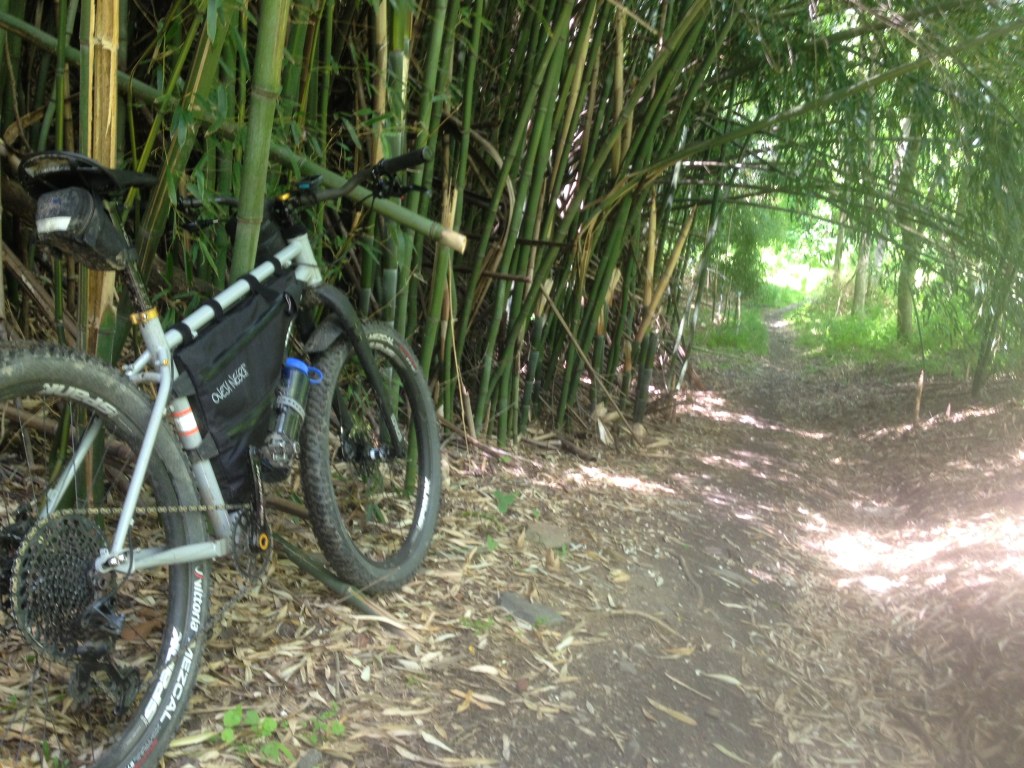
I brought my Knipex pliers wrench back home from work yesterday. I’m still going to be working on bikes a few days a week, but it feels like it’s time to find that emptiness again. In the Krasznahorkai story, the character is recentered with the bicycle after a day with a Western apprentice in his studio, watching and asking questions, disrupting the ritual of his work. The emptiness exists at work, at rest, and while riding in the forest. It’s actually pretty easy to find that emptiness. Or maybe it’s not easy, but it is simple. At work, fixing a bike means going through a cycle that tries to take you away from the central emptiness. Customers offer confused explanations of problems, a bicycle rarely presents its problems in a straightforward way, and the temporality of bicycle maintenance and repair is never linear. But finding the emptiness and clarity is simple, and involves a process of mindfulness like riding through the forest, uphill and downhill, described by Krasznahorkai. Trust the satisfactory ability of your tools, keep pressing forward, and glide down without thinking about the brakes.
I’m starting this personal writing to help find that emptiness again, because I haven’t had it while fixing bicycles for some time now. Business always gets in the way of business, and now I am laid off part-time with the rest of my fellow workers. I think that reflecting less on broken bicycles will help me move forward and to see how they fit into my life and the world at large as objects, functional and aesthetic, once again.
 almost anything
Leave a comment